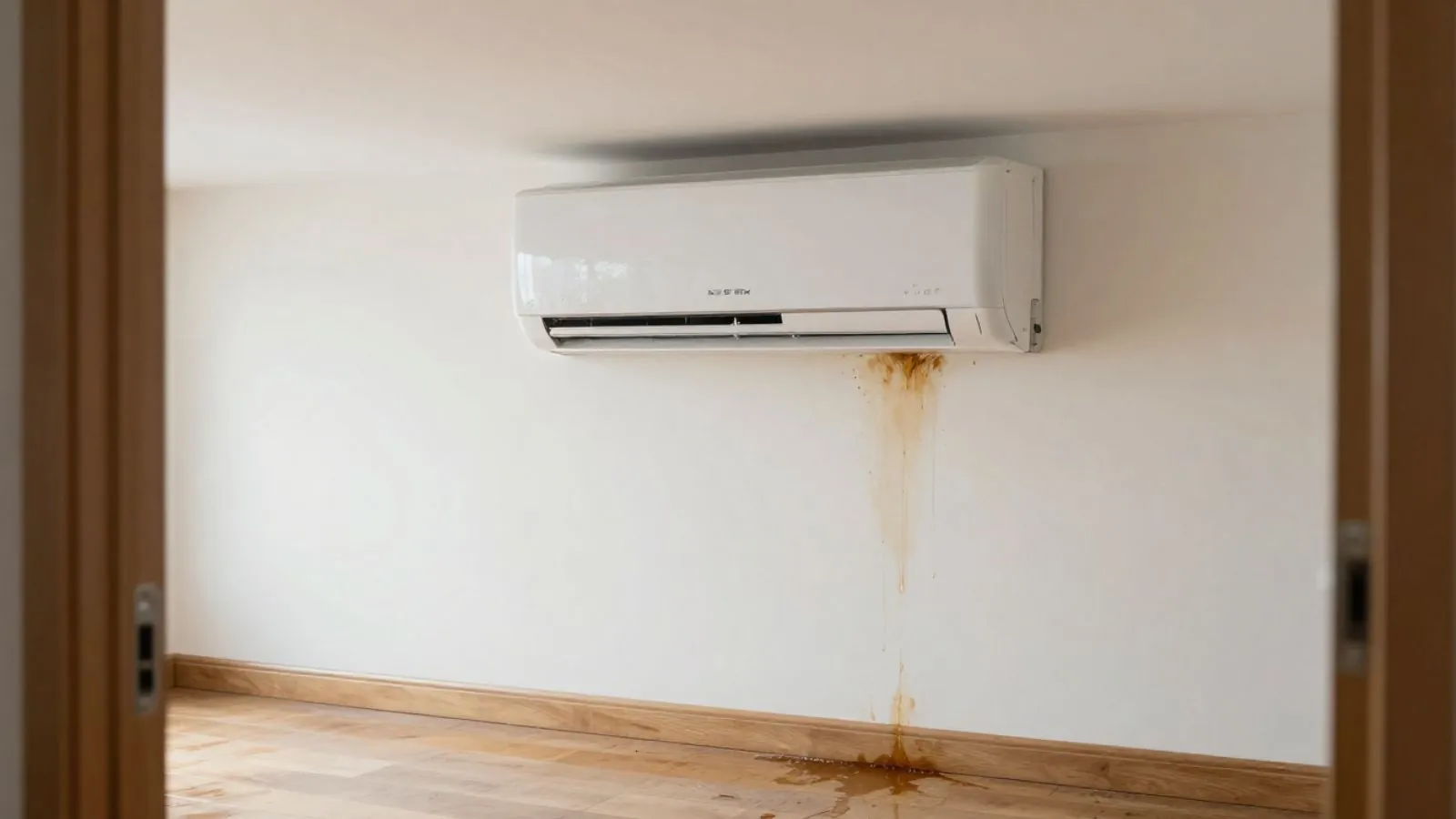
AC leak water damage comes from condensate, the water that forms on a cooling coil and drains away through a pipe or pan. When the drain clogs, the pan overflows and water goes where it should not: into an attic, a closet, a ceiling or a wall.
Because this water drips slowly, it is not always an emergency, but a stain that is growing deserves a call. Turn off the air conditioner at the thermostat to stop making more condensate, and call us for moisture mapping.
Air conditioner leaking: what to check first
Condensate is usually clean, but it can carry algae and dust.
- Switch the air conditioner off at the thermostat to stop the flow.
- Place a bucket or towels under the drip. If the ceiling is bulging, keep clear of it.
- Photograph the stain, the drain pan or the unit if you can see it.
- Call us for moisture mapping, and call an HVAC technician to clear the drain.
Why a drain line leaks
The drain line carries condensate away from the cooling coil. It clogs with algae, dust and debris, and when it does, the pan overflows. In an attic unit, the overflow lands on the ceiling below. In a basement or closet unit, it soaks the floor and the wall base. Mini-split units can also drip from the wall into the room.
A secondary drain pan or a float switch limits the damage, but not every installation has one. Whether to add one is an HVAC question. Whether the ceiling and insulation are dry is ours.
What gets wet and what gets dried
Attic insulation soaked with condensate loses its value and stays damp for a long time. Ceiling drywall gets stains and softens, and a ceiling directly under an air handler can sag. We map the moisture, remove what cannot be dried, and dry the rest. For ceilings, see ceiling water damage repair.
A drip that has gone on for weeks leaves rings that look like old stains. Moisture readings tell us whether the area is still wet or has dried.
HVAC water damage and mold
Slow, repeated moisture near a cooling system is the sort of condition that supports mold growth. Mold needs moisture, and removing the moisture is the first step. Testing and remediation follow the ANSI/IICRC S520 standard, and health questions are for a physician. This site does not diagnose mold, and we do not promise that mold will not return.
Where an AC leak shows up
| Unit location | Where water goes | What is dried |
|---|---|---|
| Attic air handler | Ceiling below and attic insulation | Ceiling, insulation and framing |
| Closet or basement unit | Floor, wall base and stored items | Baseboards, subfloor and drywall base |
| Mini-split indoor unit | Wall and floor under the unit | Wall cavity and baseboard |
| Rooftop or commercial unit | Roof deck and ceilings below | See commercial water damage restoration |
Drying after the drain is fixed
An HVAC technician clears the drain line or repairs the pan. After that, the wet ceiling, insulation and framing still need to be dried. Structural drying covers how readings show when the cavity is dry.
If the leak came through the ceiling below, water extraction may be needed first for any water on the floor.
What to do first
- Stay out of any room where water is touching outlets, cords or appliances, and shut off power to that area at the breaker only if the panel is dry and you can reach it without standing in water.
- If it is safe, stop the source by closing the nearest shutoff valve or the main valve.
- Keep children and pets away from standing water, since it may carry contamination.
- Take photos before moving anything, then call for help.
What affects the cost of AC leak water damage repair
AC leaks are slow, so the cost follows how long it ran.
- How long it dripped
- Weeks of drips mean more insulation and drywall are affected.
- Insulation involved
- Saturated attic insulation is removed and counted.
- Ceiling or wall type
- Drywall, plaster and finishes dry differently.
- Access
- An attic or crawlspace that is hard to reach adds labor.
- Drying days
- Equipment runs until readings are normal.
Costs are explained before work starts, and the written scope is the document to compare against your policy. Want your real number? Call (833) 521-1033 and describe what you see.
Frequently asked questions
Is an AC leak an emergency?
A fast leak or a bulging ceiling is an emergency, and the dispatch line is open 24/7. A slow stain is still worth a prompt call.
Do you fix the air conditioner?
No. An HVAC technician clears the drain and repairs the unit. We dry the damage.
Does insurance cover AC leak damage?
Policies differ, and gradual leaks are often excluded. Ask your insurer.
How can I prevent AC drain leaks?
Regular HVAC maintenance and clearing the drain line help. A float switch can shut the unit down if the pan fills.
Will the stain go away on its own?
No. Stains stay, and the material behind them may still be wet.