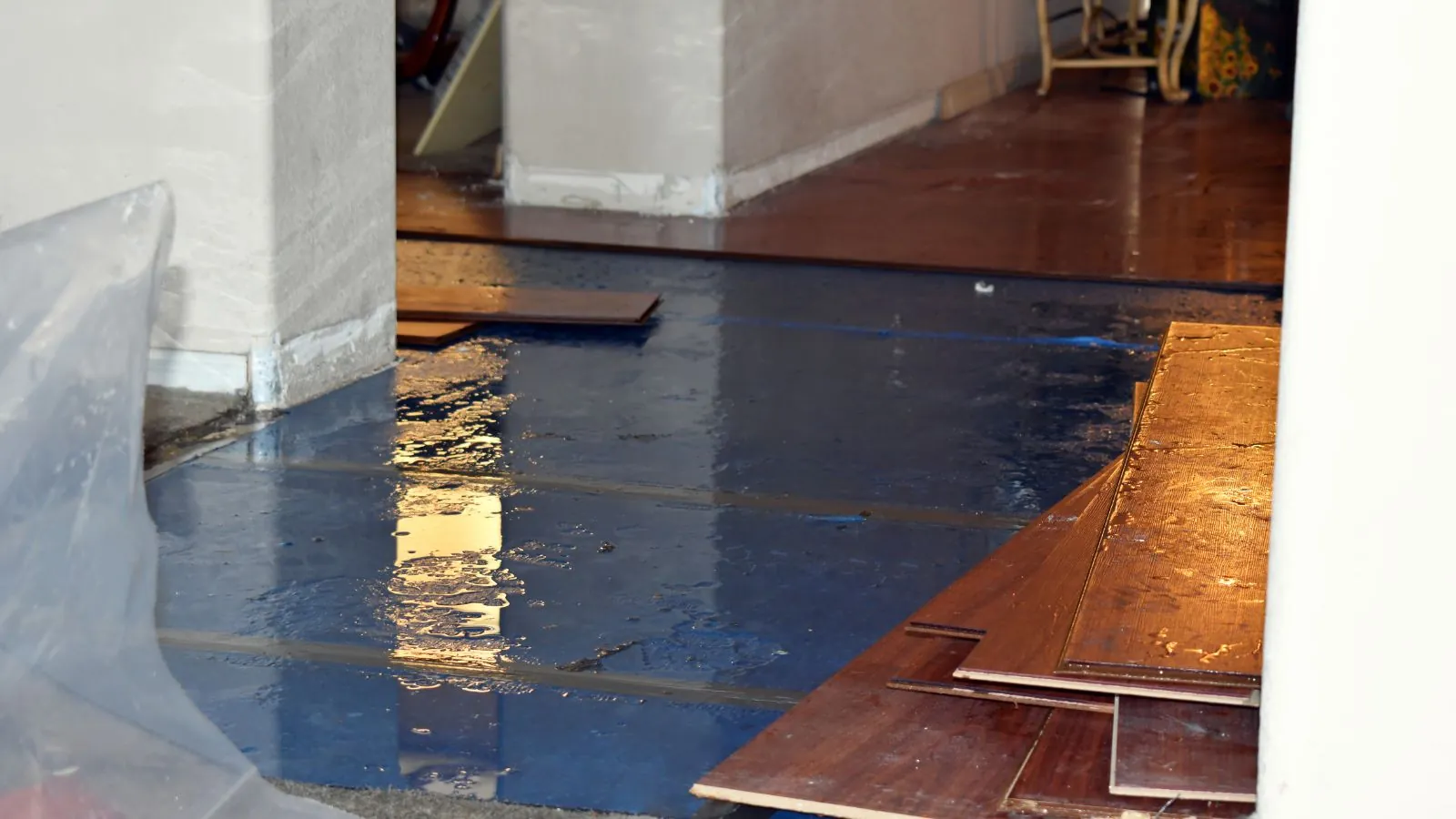
Hardwood floor water damage repair covers solid wood, engineered wood and laminate floors after a leak, flood or spill. Wood takes on water at the edges and underside, and the first sign is often cupping, with the edges of each board lifting higher than the center.
Speed matters because wood that stays wet can buckle or develop dark staining. If water is still on the floor, call the dispatch line and start with extraction.
Wet wood floor: what to do now
The first days decide whether a floor is dried or replaced.
- Stop the source and remove standing water and wet rugs.
- Do not seal the floor with a plastic sheet or put heavy items on it.
- Keep the room at a normal temperature and avoid space heaters on wet wood.
- Call us for moisture mapping before the floor is sanded or refinished.
Cupping, crowning and buckling
Cupping happens when the underside of a board is wetter than the top. Crowning is the opposite and often follows a floor that was sanded while still damp. Buckling is when boards lift off the subfloor, and it generally means the floor was wet for a long time.
Moisture meters on the boards and the subfloor guide the decision. If the readings fall as the floor dries, cupped boards can flatten, and refinishing may be possible. If the floor has buckled or stained black, replacement of sections is more likely.
Drying floors in place
Some floors can be dried without being lifted. Specialized equipment forces air through the boards and under them, while dehumidifiers pull the moisture out. Where the subfloor is wet, boards may be removed at the edge to allow airflow. These methods work best on clean water that has not been sitting for days.
A floor that was wet for a long period, or soaked by contaminated water, is more likely to be replaced. The assessment will tell you, and the written scope documents what was removed so your insurer and contractor have a record.
Why wood floors in older Bethlehem homes are special
The City of Bethlehem's Northside 2027 plan lists a median construction year of 1940 for the Northside and 1955 for the city as a whole. In houses of that age, original or early replacement wood floors are common, and solid wood can often be sanded and refinished after it dries. That is a reason to try drying first.
For floors over a basement or crawl space, water from below is possible, and crawl space water damage and basement water damage cleanup describe those sources. A wet subfloor under a dry-looking board is the usual reason a floor cups weeks later, so the subfloor reading matters as much as the board reading. Wet wood near a wall is covered in structural drying.
Floor types and typical outcomes
| Floor type | Behavior when wet | Typical outcome |
|---|---|---|
| Solid hardwood | Cups and can be refinished if dried | Often saved if caught early |
| Engineered wood | Layers can separate | Mixed, depends on layers |
| Laminate | Core swells and does not recover | Often replaced |
| Parquet | Tiles lift from adhesive | Replaced or reset in sections |
Standards that guide the work
Floor drying decisions are usually made with reference to ANSI/IICRC S500, the industry standard for water damage restoration, along with the flooring manufacturer's own guidance. Moisture readings, not appearance alone, decide whether a floor can be saved.
What affects the cost of hardwood floor water damage repair
The cost depends on whether the floor is dried and refinished or replaced.
- Floor type
- Solid wood, engineered and laminate floors behave differently.
- Time wet
- Days of water make replacement more likely.
- Area
- A room is different from a whole level.
- Subfloor
- A wet subfloor adds drying or replacement.
- Refinishing
- Sanding and finishing are rebuild steps, not drying steps.
Costs are explained before work starts, and the written scope is the document to compare against your policy. Want your real number? Call (833) 521-1033 and describe what you see.
Frequently asked questions
Can a cupped floor flatten on its own?
Often yes if the moisture source is fixed and the floor dries slowly. Do not sand until readings are normal.
Should I pull up the boards myself?
No. Pulling boards can damage the tongue and groove. Let the crew decide what to lift.
Do you refinish floors?
We dry and document. Sanding and refinishing are rebuild steps.
Do you handle hardwood floor emergencies at night or on weekends in Bethlehem?
The dispatch line is answered 24/7. Call if water is still on the floor.
Will insurance cover hardwood floors?
Sudden leaks are often covered, and slow leaks often are not. Ask your insurer.